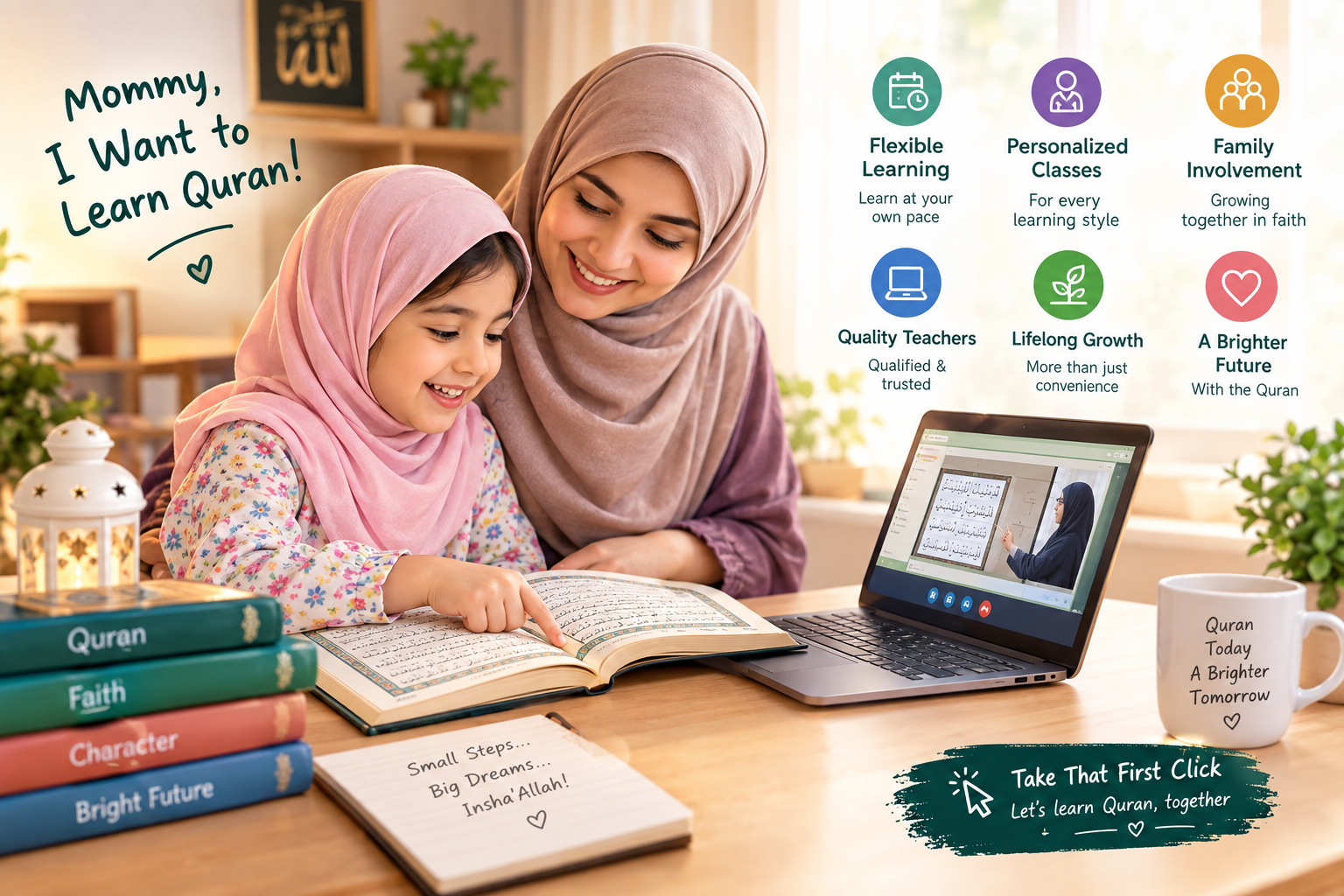
There are some moments every mother remembers. One of them is hearing her child say, “Mommy, I want to learn Quran.”
Those simple words can bring a smile to your face and a beautiful sense of gratitude to your heart. You want to encourage that interest, but then comes the practical question: Where should we start?
Finding the right teacher, managing school schedules, arranging transportation, and keeping your child interested can feel challenging. Thankfully, learning the Quran no longer has to depend on finding a class nearby or fitting lessons into a busy routine.
With Online Quran Classes, children can learn from home with qualified teachers while parents remain involved in their progress. More importantly, online learning can make Quran education a natural part of a child’s everyday life.
When a Child Wants to Learn, Give That Curiosity a Chance
Children learn best when they feel genuinely interested in something. If your child approaches you and says they want to learn the Quran, that curiosity is worth nurturing.
Instead of making the experience feel like another school subject, parents can help children see Quran learning as a meaningful and enjoyable journey.
The first step is simply to listen.
Ask your child what they would like to learn. Maybe they want to improve their Quran reading, learn short Surahs, understand basic Islamic teachings, or simply learn how to read Arabic properly.
Understanding their interest can help you choose a learning approach that feels comfortable rather than overwhelming.
What Makes Online Quran Learning Easier for Families?
Family schedules can be unpredictable. School, homework, extracurricular activities, family commitments, and everyday responsibilities can leave little room for another fixed appointment.
This is where online learning can offer practical flexibility.
With online Quran lessons, your child can study from a familiar environment without spending time travelling to and from a physical classroom. Parents can choose lesson times that fit more comfortably around the family’s routine.
A child can finish homework, have a short break, and then join a Quran lesson from home.
That convenience can make it easier to maintain consistency, which is an important part of learning any new skill.
A Learning Experience Built Around Your Child
Every child learns differently.
Some children pick up Arabic letters quickly, while others need more repetition. Some enjoy asking questions throughout the lesson, while others prefer listening and practising quietly.
A good Quran learning program should recognize these differences.
Personalized lessons can give children the opportunity to learn at a pace that suits them. A teacher can identify areas where the child needs more practice and adjust the lesson accordingly.
Instead of rushing through a fixed syllabus, children can gradually build their confidence in areas such as:
- Arabic letters and pronunciation
- Quran reading
- Tajweed fundamentals
- Short Surahs
- Memorization
- Basic Islamic teachings
- Regular Quran practice
The goal is not simply to complete lessons. It is to help children develop a lasting connection with the Quran.
How Parents Can Become Part of the Journey
Online learning does not mean parents have to stay completely outside the classroom.
In fact, parents can play an important role in keeping children motivated.
You can ask your child what they learned after each lesson. You can listen as they practise a Surah. You can celebrate small improvements and encourage them when something feels difficult.
Even a few minutes of encouragement can make a child feel proud of their progress.
Instead of asking only, “Did you finish your lesson?” try asking questions such as:
“What did you learn today?”
“Which part did you enjoy?”
“Would you like to practise it together?”
These small conversations can turn Quran learning into a shared family experience.
How to Choose the Right Online Quran Program
With so many online options available, choosing a suitable program can take some research.
Start by considering your child’s age, current Quran reading ability, learning goals, and personality.
Look for a program that provides qualified teachers and lessons appropriate for your child’s level. It is also useful to understand how classes are conducted, how progress is monitored, and how parents can communicate with teachers.
Before enrolling, consider asking:
- Are teachers experienced in teaching children?
- Are lessons suitable for beginners?
- Can class timings fit our family schedule?
- Does the program offer individual attention?
- How is the child’s progress tracked?
- Is there an opportunity to try a class before enrolling?
Taking time to find the right fit can make the learning experience much more comfortable for both you and your child.
Making Quran Time Something Your Child Looks Forward To
Children naturally respond to encouragement.
If Quran lessons are constantly presented as a responsibility or obligation, a child may begin to associate them with pressure. A more positive approach can help create a healthier relationship with learning.
Create a quiet and comfortable learning corner at home. Keep the environment free from unnecessary distractions. Make sure your child has enough time to prepare for their lesson instead of joining at the last minute.
Most importantly, celebrate progress.
If your child finally reads a difficult verse correctly, learns new Arabic letters, or memorizes a short Surah, acknowledge the effort.
Small achievements can build confidence and encourage children to keep going.
Quran Learning Is More Than Reading Words
Learning the Quran is not simply about recognizing Arabic letters or memorizing verses.
It can also become an opportunity for children to develop patience, discipline, reflection, and a deeper understanding of their faith.
As children grow, their relationship with the Quran can grow with them.
What begins with learning the Arabic alphabet can eventually develop into confident Quran reading, memorization, understanding, and regular reflection.
That is why creating positive learning habits from an early age can be so meaningful.
Start Small and Let the Journey Grow
You do not need to make your child’s Quran journey complicated.
Start with the level that feels right for them. Give them time to learn. Encourage questions. Celebrate progress. Most importantly, avoid comparing their journey with another child’s.
Every learner has a different pace.
With the right teacher, a supportive home environment, and consistent Online Quran Classes, your child can gradually develop confidence and familiarity with the Quran.
And one day, that little voice saying, “Mommy, I want to learn Quran,” may become the same voice confidently reciting its verses.
Frequently Asked Questions
1. What age is suitable for children to start learning the Quran?
There is no single perfect age for every child. Many children begin learning Arabic letters and basic Quran reading at a young age, while others may start later. The important thing is to choose lessons that match the child’s maturity, attention span, and current abilities.
2. Are Online Quran Classes suitable for beginners?
Yes. Online Quran lessons can be designed for complete beginners who are still learning Arabic letters and basic pronunciation. A suitable teacher can gradually introduce reading, pronunciation, Tajweed, and memorization according to the child’s level.
3. How can parents keep children interested in Quran learning?
Parents can encourage children by celebrating progress, listening to their recitation, creating a comfortable learning environment, and showing genuine interest in what they are learning. Positive encouragement can make lessons feel rewarding rather than stressful.
4. What should parents look for in an online Quran teacher?
Parents should consider the teacher’s Quran knowledge, teaching experience, communication skills, ability to work with children, and approach to individual learning needs. A teacher who can explain concepts patiently and keep children engaged can make a significant difference.
5. Can children learn Quran from home through online classes?
Yes. Online Quran learning allows children to attend lessons from home using an internet-connected device. This can provide families with greater scheduling flexibility while allowing children to learn with a teacher without travelling to a physical classroom.
A Beautiful Beginning Can Start With One Simple Question
“Mommy, I want to learn Quran.”
Sometimes, the most meaningful journeys begin with the simplest words.
If your child has shown an interest in learning the Quran, encourage that spark. Find a learning environment where they feel comfortable, supported, and motivated to improve.
With patience, consistency, and the right guidance, those first few lessons can become the beginning of a lifelong relationship with the Quran.