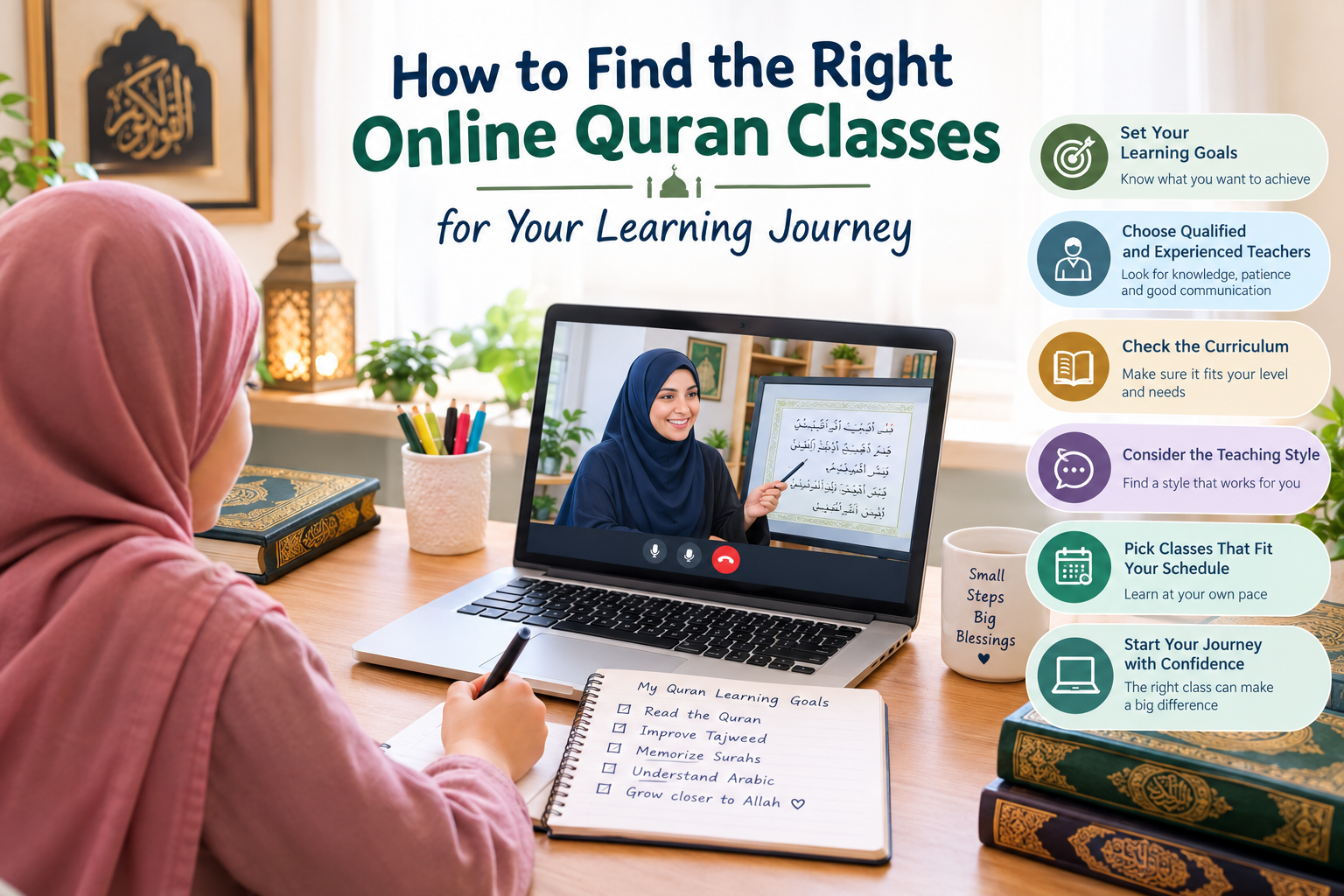
Learning the Quran is a meaningful journey that requires patience, consistency, and the right guidance. While traditional Quran classes remain valuable, online learning has made it easier for students of different ages and backgrounds to find qualified teachers without leaving home.
The challenge is that there are now many online Quran learning options available. How do you know which teacher is right for you? What should you look for in an online Quran academy? And how can you tell if a teacher’s teaching style will actually suit your learning needs?
Choosing a Quran teacher is about more than finding someone who can recite the Quran. You need a teacher who understands your level, explains concepts clearly, corrects your mistakes patiently, and creates a comfortable environment for learning.
Here are some important factors to consider before choosing your online Quran classes.
Why Learn the Quran Online?
Online Quran education offers a level of convenience that traditional classes may not always provide. Students can attend lessons from home without spending time travelling to a local learning centre.
This flexibility can be especially helpful for people with busy schedules. Parents can arrange lessons around their children’s school routines, while adults can choose classes that fit around work and family responsibilities.
Online learning can also give students access to teachers from different backgrounds and teaching styles. Instead of being limited to the teachers available in your local area, you can explore different instructors and find someone whose approach suits you.
For students who prefer learning privately or in a familiar home environment, online classes can also make the learning experience more comfortable.
Start by Defining Your Quran Learning Goals
Before searching for a teacher, think about what you actually want to learn.
Not every student begins with the same goal. A beginner may need help learning the Arabic letters and basic pronunciation, while another student may already know how to read and want to improve their Tajweed.
Your goals might include:
- Learning to read the Quran from the beginning
- Improving Quran pronunciation
- Learning Tajweed rules
- Memorising selected Surahs
- Completing Hifz
- Understanding Quranic Arabic
- Revising previously memorised portions
- Helping children develop regular Quran reading habits
Knowing your goal makes it easier to find a teacher who has experience in the specific area you need.
Look for Qualified and Experienced Quran Teachers
The quality of your teacher can have a major impact on your learning experience.
A knowledgeable Quran teacher should have a strong understanding of Quranic recitation and the rules of Tajweed. However, knowledge alone is not enough. Teaching requires patience, communication skills, and the ability to explain concepts according to a student’s level.
A good teacher should be able to identify pronunciation mistakes and explain how to correct them rather than simply pointing out that something is wrong.
This becomes particularly important when teaching children or complete beginners. Students may need concepts explained several times before they fully understand them.
When comparing teachers, look at their qualifications, teaching experience, areas of expertise, and student feedback.
Pay Attention to the Curriculum
A well structured curriculum gives your learning journey direction.
Before enrolling, find out what the classes actually cover. If you are a beginner, the course might start with Arabic letters, pronunciation, and basic reading skills before moving towards complete Quranic verses.
More advanced students may need a curriculum focused on Tajweed, Hifz, or Quranic Arabic.
Ask questions such as:
- What will I learn during the first few classes?
- How will my progress be measured?
- Can the lessons be adapted to my current level?
- Does the teacher provide revision exercises?
- How frequently will my recitation be assessed?
A flexible curriculum can be especially useful because students progress at different speeds.
Consider the Teacher’s Communication Style
A teacher can have excellent qualifications and still not be the right fit for every student.
Some learners prefer a structured and serious teaching style, while others learn better when the teacher is conversational and encouraging.
During an introductory lesson, pay attention to how the teacher communicates. Do they listen carefully? Do they correct mistakes respectfully? Are their explanations easy to understand?
For children, look for someone who can maintain their attention and encourage them without making the lesson feel stressful.
The right teacher should make you feel comfortable asking questions. Quran learning is a gradual process, and students should never feel embarrassed about making mistakes while learning.
Choose Classes That Fit Your Schedule
One of the biggest advantages of online Quran education is flexibility.
Instead of travelling to a fixed location at a specific time, you can often arrange lessons around your existing commitments.
This is particularly useful for working adults, parents, students, and families with different schedules.
Before enrolling, check how scheduling works. Some platforms provide fixed lesson times, while others allow students to choose from available time slots.
Try to choose a schedule that you can maintain consistently. Attending one class occasionally is unlikely to produce the same progress as regular lessons supported by personal revision.
Online Quran Classes For Ladies
Many women prefer learning from female Quran teachers because they feel more comfortable discussing questions and receiving personalised guidance in a familiar learning environment.
When looking for Online Quran Classes For Ladies, consider whether the program offers qualified female teachers with experience teaching adult women and young girls.
Female students may have different schedules and learning requirements, particularly when balancing family responsibilities, work, or studies. Flexible online lessons can make it easier to maintain a consistent Quran learning routine.
Parents looking for Quran education for their daughters may also prefer a female instructor who can create a comfortable and supportive learning environment.
The important thing is to choose a teacher based on qualifications, teaching ability, communication, and compatibility with the student’s needs.
Take Advantage of a Trial Lesson
A trial class can tell you more about a teacher than a long description on a website.
Use the opportunity to experience the teaching style firsthand. Pay attention to how the teacher begins the lesson, explains concepts, corrects mistakes, and responds to questions.
You can also use the trial session to determine whether the online classroom technology works well for you.
Before committing to a long term course, ask yourself:
- Did I understand the teacher’s explanations?
- Did I feel comfortable asking questions?
- Was the lesson organised?
- Did the teacher pay attention to my mistakes?
- Did the pace feel appropriate?
- Would I enjoy learning with this teacher regularly?
If the answer to most of these questions is yes, you may have found a good match.
Read Reviews and Student Feedback
Student reviews can provide useful insight into the learning experience.
When reading reviews, do not focus only on the overall rating. Look for comments about specific teachers, teaching methods, punctuality, communication, lesson quality, and student progress.
Reviews can help you understand what other learners experienced before making a decision.
However, remember that every student is different. A teacher who works exceptionally well for one learner may not have the same teaching style another student prefers. Use reviews as one part of your decision rather than the only factor.
Make Sure the Technology Is Easy to Use
Online Quran learning depends on technology, so a reliable learning environment matters.
You should have access to a stable internet connection, a device with a good microphone, and a quiet place where you can concentrate.
The learning platform should ideally make it easy to communicate with your teacher and attend lessons without unnecessary technical difficulties.
If a student spends more time dealing with connection problems than learning, the experience can quickly become frustrating.
For younger children especially, a simple and easy to navigate online classroom can make lessons much smoother.
Think About Your Learning Environment at Home
A comfortable learning environment can improve concentration.
Try to attend your Quran lesson from a quiet area where you are unlikely to be interrupted. Keep your Quran and any required learning materials nearby before the lesson begins.
Parents can also help younger children by establishing a regular routine. When Quran lessons take place at approximately the same time each week, children can gradually become accustomed to the schedule.
Adults can use the same approach by treating Quran lessons as a regular part of their weekly routine rather than something they attend only when they have free time.
Don’t Focus Only on Price
Cost is naturally an important consideration, but it should not be the only factor.
A cheaper class is not necessarily better value if the teaching quality is poor or the schedule does not work for you. Similarly, a more expensive course may not be necessary if it provides services you do not actually need.
Compare the overall learning experience, including teacher qualifications, class structure, flexibility, lesson frequency, resources, and student support.
Your objective should be to find a learning option that provides quality instruction and fits your circumstances.
Build Consistency Into Your Quran Learning Routine
Finding the right teacher is only the beginning.
Progress requires regular practice between lessons. Review the verses covered during class, practise difficult pronunciations, and revise previous lessons.
If you are learning Tajweed, try to apply the rules while reciting rather than simply memorising their definitions.
If you are working towards Hifz, consistent revision is equally important. Memorising new portions without revisiting previous ones can make it difficult to retain what you have already learned.
Small amounts of regular practice can be more effective than occasional long study sessions.
Final Thoughts
Finding the right online Quran teacher does not have to be difficult when you know what to look for.
Start by identifying your learning goals and current level. Then consider teacher qualifications, curriculum, communication style, schedule flexibility, reviews, and the overall learning environment.
A trial class can also help you determine whether a particular teacher is a good fit before you commit to regular lessons.
For women and girls who prefer learning with female instructors, Online Quran Classes For Ladies can provide access to suitable teachers while offering the comfort and flexibility of learning from home.
Most importantly, remember that Quran learning is a journey. You do not need to master everything immediately. With the right teacher, consistent practice, and sincere effort, you can gradually improve your recitation, understanding, and connection with the Quran.
Frequently Asked Questions
1. How do I choose the best online Quran teacher?
Look for a teacher with strong Quranic knowledge, relevant teaching experience, good communication skills, and a patient teaching style. Reviews and trial lessons can also help you determine whether the teacher suits your learning needs.
2. Are online Quran classes suitable for beginners?
Yes. Online classes can be suitable for complete beginners as long as the teacher offers lessons appropriate to their level. Beginners can start with Arabic letters, pronunciation, basic reading, and gradually progress towards Quranic recitation.
3. Can women learn Quran from female teachers online?
Yes. Many online Quran learning programs offer female teachers. This can be a comfortable option for women and girls who prefer learning from a female instructor.
4. How often should I attend online Quran classes?
The ideal frequency depends on your goals and schedule. Regular lessons combined with practice between classes can help you make steady progress. Consistency is generally more important than studying intensively for a short period.
5. What should I learn first when starting Quran classes?
Beginners usually start by learning Arabic letters, correct pronunciation, basic reading skills, and foundational recitation rules. A qualified teacher can assess your current level and recommend an appropriate learning path.