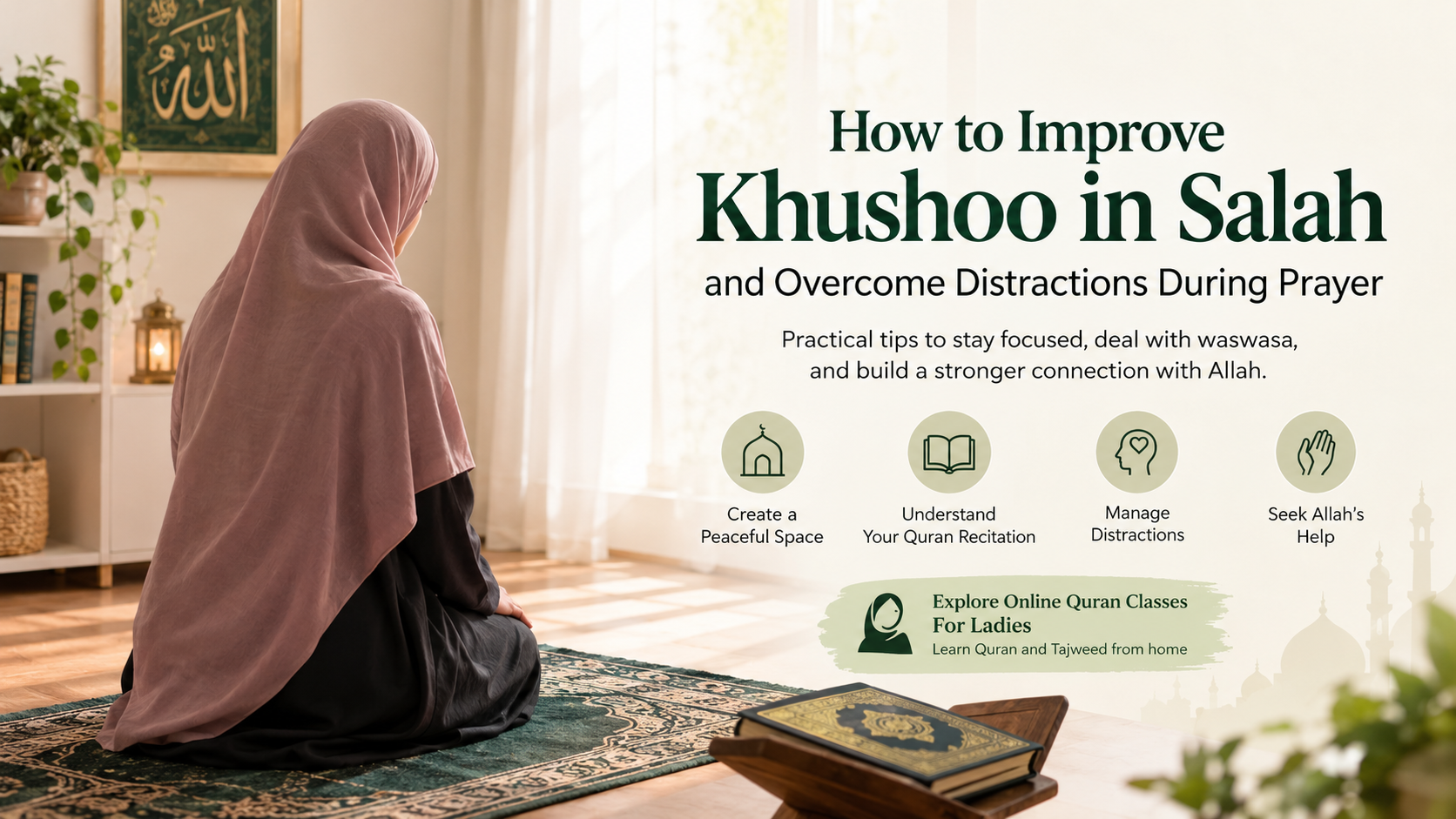
Salah is more than a daily act of worship. It is a moment to step away from worldly concerns, remember Allah, and reconnect with the purpose of our lives. Yet, many Muslims struggle to maintain concentration during prayer. Thoughts about work, family responsibilities, unfinished tasks, and everyday worries can make it difficult to remain focused from the opening Takbeer to the final Salaam.
This state of attentiveness and humility in prayer is known as Khushoo. Developing Khushoo takes patience, sincerity, and consistent effort. It also requires identifying the things that distract the heart and mind and learning how to respond to unwanted thoughts without becoming discouraged.
By making small changes to your surroundings, preparing yourself before Salah, and learning more about the Quran, you can gradually build a stronger connection with your prayers.
What Is Khushoo and Why Does It Matter in Salah?
Khushoo refers to humility, attentiveness, and a sense of reverence before Allah during worship. It means approaching Salah with an awareness of standing before your Creator rather than simply completing a religious obligation.
When a person experiences Khushoo, they make an effort to understand the words they recite, reflect on their meaning, and remain conscious of their actions throughout the prayer. Their body performs the movements of Salah while their heart strives to remain connected to Allah.
However, concentration does not always come easily. A person may begin praying with sincere intentions but suddenly remember an important conversation or start worrying about something that happened earlier in the day. Such experiences are common, and they do not mean that improving Khushoo is impossible.
The goal is to keep returning your attention to Salah whenever your mind wanders. With practice, preparation, and Allah’s help, you can work towards making prayer more meaningful.
1. Prepare a Peaceful Space for Prayer
Your surroundings can significantly affect your ability to concentrate. A room filled with noise, movement, and unnecessary visual distractions can make it harder to focus on worship.
Before beginning Salah, take a few moments to prepare your prayer area. Choose a reasonably quiet place where people are less likely to interrupt you. If possible, keep your prayer mat away from televisions, busy walkways, and areas where family members frequently gather.
Remove objects that might attract your attention. Decorative curtains, bright patterns, pictures, and other visually striking items may draw your eyes away from prayer. A simple, tidy space can help you direct your attention towards worship.
Temperature and physical comfort also matter. If the room is excessively hot or cold, you may find yourself thinking more about your discomfort than your Salah. Make reasonable adjustments when possible so you can pray with greater ease.
You do not need a perfectly silent or specially decorated room to develop Khushoo. What matters is making a sincere effort to reduce avoidable distractions and create an environment that supports your worship.
2. Choose Comfortable and Uncomplicated Prayer Clothing
What you wear during Salah can also influence your concentration. Clothing that requires repeated adjustments, feels uncomfortable, or contains distracting patterns may draw your attention away from prayer.
Choose clean, appropriate clothing that allows you to perform Ruku and Sujood comfortably. Avoid garments that repeatedly slip, become tangled, or require you to keep fixing their position during Salah.
The aim is not to make clothing an additional source of worry. Instead, prepare yourself beforehand so you can focus on remembering Allah rather than managing your clothes.
Before starting your prayer, check that your clothing is arranged properly and that you feel comfortable. This small habit can help prevent unnecessary movement and interruptions.
3. Avoid Praying While Distracted by Hunger or Physical Needs
Physical discomfort can make concentration difficult. If food has been prepared and you are genuinely hungry, your attention may keep returning to the meal instead of the prayer.
Islamic teachings address this situation by encouraging a person to eat when food is ready and the desire to eat would interfere with concentration, provided there is sufficient time to perform the prayer within its prescribed time.
Similarly, do not unnecessarily delay attending to the call of nature when you need to use the bathroom. Trying to suppress such an urge can distract you throughout Salah and make it difficult to remain attentive.
Prepare for prayer by taking care of reasonable physical needs beforehand. This does not mean delaying Salah carelessly or allowing prayer times to pass. It means balancing your responsibilities so that you can approach worship with greater presence of mind.
4. Manage Tiredness Before Beginning Salah
Sleepiness can affect your understanding of what you are reciting and make it difficult to maintain attention. When a person is extremely tired, their mind may wander repeatedly, even when they sincerely want to concentrate.
The Prophet Muhammad (peace and blessings be upon him) taught that a person who becomes sleepy during prayer should rest until they understand what they are saying.
Try to maintain a healthy sleep routine and avoid leaving yourself unnecessarily exhausted before prayer. If your schedule allows, rest when you need to and organise daily tasks so that tiredness does not regularly interfere with worship.
If you feel your attention slipping because of fatigue, recognise the problem and take reasonable steps to address it. Khushoo is not developed through physical exhaustion but through sincere worship accompanied by attentiveness and understanding.
5. Reduce Noise and Avoid Disturbing Other Worshippers
A peaceful environment is important not only for your own prayer but also for the people praying around you.
Conversations, unnecessary movement, and loud recitation can distract others who are trying to concentrate. The Prophet Muhammad (peace and blessings be upon him) instructed worshippers not to raise their voices over one another while reciting the Quran.
When praying in a mosque or with others, remain mindful of the people around you. Avoid unnecessary conversation and follow the appropriate volume for the prayer you are performing.
At home, you can also establish a simple routine with family members. Let them know when you are praying so they can avoid unnecessary interruptions whenever possible.
If someone else makes a noise or a distraction occurs unexpectedly, try not to let frustration become another distraction. Return your attention to Salah and continue calmly.
6. Keep Your Movements Calm and Avoid Unnecessary Actions
Khushoo involves both the heart and the body. Constant movement can interrupt concentration and make prayer feel rushed.
Avoid repeatedly adjusting your prayer mat, smoothing the ground without a need, touching your clothes, or looking around during Salah. Prepare your surroundings before beginning so that you are less likely to feel the need to make adjustments.
The Prophet Muhammad (peace and blessings be upon him) discouraged unnecessary actions during prayer. His guidance teaches Muslims to approach Salah with calmness and to avoid movements that have no real purpose.
You should also avoid raising your gaze towards the sky during prayer. Keep your attention directed appropriately rather than allowing your eyes to wander around the room.
If you feel the urge to move or check something, pause and consider whether it is genuinely necessary. Reducing unnecessary actions can help you become more aware of the words and movements of your prayer.
7. Learn to Deal With Waswasa During Salah
Waswasa refers to unwanted whispers, doubts, or distracting thoughts that can interfere with worship. These may involve everyday worries, repeated doubts about your actions, or uncertainty about details of the prayer.
A person experiencing waswasa may begin Salah with full attention but suddenly find their mind filled with unrelated thoughts. They may also become worried about whether their prayer is valid or whether they performed a particular action correctly.
The first step is to avoid becoming overwhelmed by every thought that enters your mind. An unwanted thought is not the same as deliberately choosing to abandon concentration. When you notice your attention wandering, gently bring it back to your recitation and the act of worship.
Do not repeatedly restart your prayer simply because you experienced distraction. Unwanted thoughts alone do not automatically invalidate Salah. Questions involving genuine mistakes, missed obligations, or specific doubts may require guidance from a knowledgeable scholar.
You can also seek refuge in Allah from Shaytan and ask Allah to help you maintain sincerity and concentration. Most importantly, do not let frustration over your lack of focus become a new obstacle to prayer.
8. Understand What You Recite in Salah
One of the most effective ways to make Salah more meaningful is to learn the meanings of the words you recite.
When you understand Surah Al-Fatihah, the short surahs you regularly read, and the supplications used in Ruku and Sujood, prayer becomes more than a sequence of familiar sounds and movements. You begin to recognise the meanings behind your recitation and reflect on what you are saying.
Set aside a little time each day to study the translation and explanation of the Quran. Start with the passages you recite most frequently in Salah and gradually expand your learning.
For women who want to strengthen their Quranic knowledge while managing family, work, or other responsibilities, Online Quran Classes For Ladies can provide a convenient way to learn from home. With suitable instruction, learners can work on Quran recitation, Tajweed, pronunciation, and understanding at a pace that fits their needs.
Learning the Quran is a gradual process. You do not need to understand everything immediately. Even learning the meaning of a few verses and reflecting on them during prayer can help you develop a deeper appreciation for Salah.
9. Ask Allah for Help in Developing Khushoo
Khushoo is not something a person can achieve through effort alone. Muslims seek Allah’s guidance and assistance in every aspect of worship, including the ability to pray with humility and sincerity.
Make Dua asking Allah to soften your heart, protect you from distractions, and help you remember Him during Salah. You can also ask for forgiveness when you notice carelessness in your worship.
Avoid becoming discouraged if your concentration improves slowly. Some days may feel easier than others, and occasional distractions do not mean that your efforts are pointless.
Instead, focus on consistent improvement. Prepare for prayer, learn the meanings of your recitation, avoid unnecessary movements, and return your attention to Allah whenever you notice your mind wandering.
A sincere effort to improve your Salah is valuable, even when perfection remains beyond your reach.
10. What Should You Do If Your Prayer Is Filled With Distractions?
Experiencing a lack of concentration raises an important question: does distraction mean that a person must repeat their prayer?
Khushoo is essential to the spiritual quality of Salah, but a lack of perfect concentration does not automatically mean that the prayer must be repeated. Islamic scholars have discussed the relationship between concentration, reward, and the validity of prayer, and some details depend on the circumstances and the school of Islamic jurisprudence followed.
Unwanted thoughts, by themselves, should not cause you to assume that your Salah is invalid. The appropriate response is to keep striving for concentration while learning the rulings that apply to genuine mistakes and doubts.
If you repeatedly experience uncertainty about whether you have completed an action correctly, avoid falling into a cycle of unnecessary repetition. Seek reliable religious guidance, particularly if these doubts are frequent and distressing.
Remember that the purpose of addressing distractions is to improve your worship, not to make Salah a source of constant fear. Approach the matter with sincerity, patience, and trust in Allah’s mercy.
Conclusion: Make Every Salah an Opportunity to Grow
Developing Khushoo is a continuous journey that requires attention, patience, and a sincere desire to become closer to Allah. Distractions may arise from your surroundings, physical discomfort, tiredness, or unwanted thoughts, but there are practical steps you can take to manage them.
Begin by preparing a peaceful prayer space, choosing comfortable clothing, taking care of your physical needs, and avoiding unnecessary movement. Learn the meanings of your Quranic recitation and ask Allah to help you remain focused during worship.
For women seeking to improve their Quran recitation and understanding, Online Quran Classes For Ladies can be a useful learning option that supports steady progress from home.
Do not measure your entire spiritual journey by one difficult prayer. Instead, keep making an effort to improve, return your attention to Allah when distractions occur, and seek knowledge that helps you worship with greater understanding.
May Allah grant us sincere hearts, protect us from harmful distractions, help us develop Khushoo in Salah, and accept our prayers. Ameen.
Frequently Asked Questions
1. What does Khushoo mean in Salah?
Khushoo means approaching prayer with humility, attentiveness, and reverence before Allah. It involves making an effort to focus on your recitation, understand its meaning, and perform the movements of Salah calmly and sincerely.
2. How can I stop my mind from wandering during prayer?
Prepare a quiet prayer area, take care of physical needs beforehand, avoid unnecessary movements, and learn the meanings of the words you recite. When your mind wanders, gently return your attention to Salah instead of becoming frustrated.
3. Does waswasa invalidate Salah?
Unwanted thoughts alone do not automatically invalidate Salah. The ruling can depend on the nature of the doubt or mistake, so consult a knowledgeable scholar if you have a specific concern. Avoid repeatedly restarting prayers solely because distracting thoughts occurred.
4. Can learning the Quran improve concentration in Salah?
Yes. Understanding the meanings of the surahs and supplications you recite can help you reflect on your prayer and develop a stronger connection with its words. Learning Tajweed can also help you improve your recitation and pronunciation.
5. How can women learn Quran recitation and Tajweed from home?
Women can explore Online Quran Classes For Ladies to study Quran recitation, Tajweed, pronunciation, and Quranic understanding remotely. When choosing a programme, look for qualified teachers, a suitable schedule, and lessons that match your current learning level.